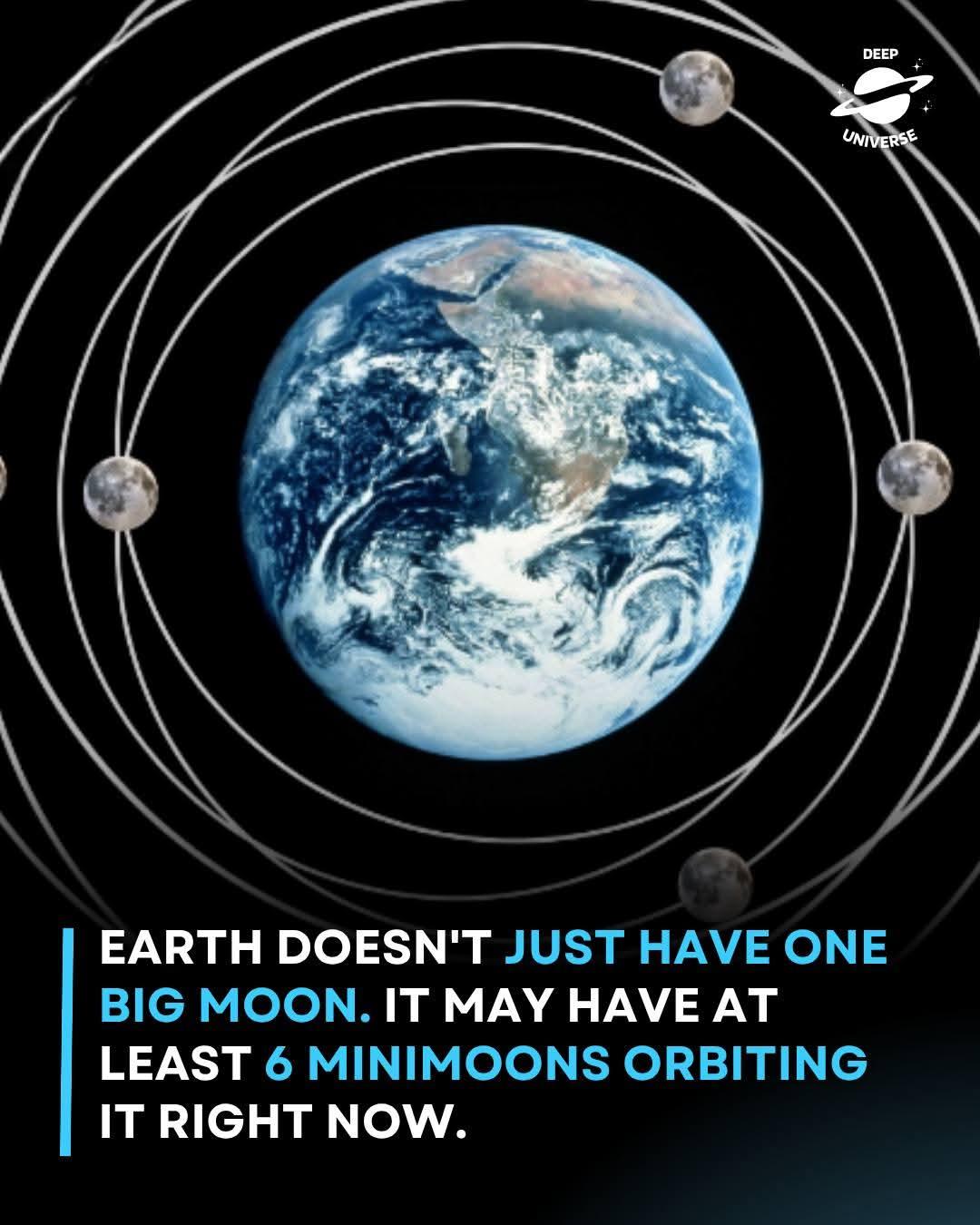
We’ve always believed Earth has just one Moon but science is now saying something very different. A new study published in Icarus reveals that Earth may be regularly orbited by tiny temporary moons called minimoons. These small celestial hitchhikers are only a few feet wide and are thought to be far more common than previously known. At any given time, Earth might have six of these tiny moons orbiting us without anyone even noticing. They don’t stay long though. On average, these visitors hang around for about nine months before drifting off to orbit the Sun. Most are believed to be fragments from the asteroid belt, but here’s the twist — some might be pieces of our own Moon, blasted into space during ancient impact events. Once freed from the Moon’s gravity, these fragments can get trapped in Earth's pull and begin a short-lived orbit around us. Because they are small and fast moving, these minimoons are tough to spot. They appear as streaks in telescope images and often slip past software detection. Still, astronomers have managed to catch a few in action like 2020 CD3 and 2024 PT5, both possibly Moon-born. These stealthy companions are more than cosmic curiosities. Since they orbit close to Earth, they could become valuable for scientific missions, space exploration, and even mining operations in the future. They may also unlock secrets about ancient asteroid impacts and the shared history of the Earth and Moon. So the next time you look up at the sky, know this, Earth may not be as alone as we think. #EarthsSecondMoon #Minimoons #TinyMoons #HiddenMoons #AstronomyFacts #SpaceExploration