
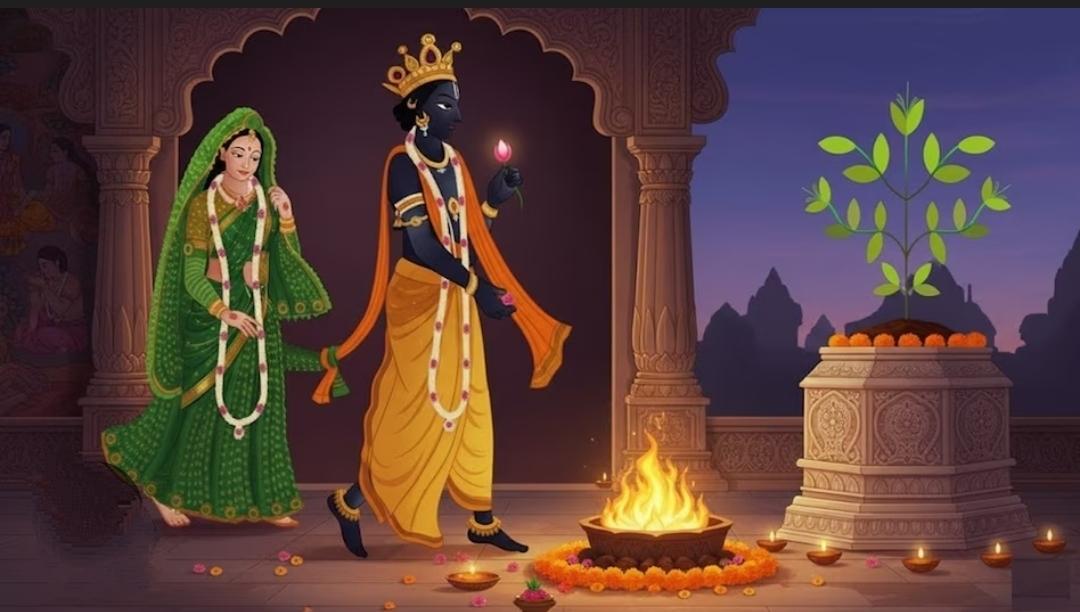
Tulsi Vivah: The Sacred Union of Tulsi and Vishnu
Tulsi Vivah is a revered Hindu festival that celebrates the ceremonial marriage of the sacred plant Tulsi (holy basil) to Lord Vishnu, often in the form of Shaligram or Krishna. This divine wedding marks the beginning of the Hindu wedding season and holds deep spiritual significance for devotees across India.
Significance of Tulsi in Hinduism
Tulsi, known as Vrinda in Hindu scriptures, is considered an earthly manifestation of Goddess Lakshmi—the consort of Lord Vishnu. Revered as a purifier of the body, mind, and soul, Tulsi occupies a special place in almost every Hindu household. Worshipping Tulsi is believed to bring prosperity, peace, and protection from negative energies.
The Legend Behind Tulsi Vivah
According to ancient lore, Vrinda was a devoted wife of the demon king Jalandhar. Her unwavering devotion made Jalandhar invincible, even against the gods. To restore cosmic balance, Lord Vishnu assumed the form of Jalandhar and deceived Vrinda, breaking her chastity and, consequently, Jalandhar’s protection. Upon realizing this, Vrinda cursed Vishnu to turn into a stone (the Shaligram) and later immolated herself. From her ashes, the Tulsi plant was born. To atone and honor her devotion, Vishnu declared that Tulsi would be eternally wedded to him. Thus, the ritual of Tulsi Vivah symbolizes their divine reunion.
Rituals and Observances
Tulsi Vivah is celebrated on the Ekadashi or Dwadashi tithi (11th or 12th day) of the bright fortnight in the month of Kartik (October–November). Devotees decorate the Tulsi plant like a bride, adorning it with a red or yellow sari, jewelry, and bangles. The Shaligram or image of Lord Vishnu is dressed as the groom. The ceremony is conducted much like a traditional Hindu wedding—with mangalashtak hymns, offering of sweets, and symbolic marriage rituals.
Married women observe fasts for family prosperity, while unmarried girls pray for a good spouse. After the rituals, devotees distribute prasad and celebrate with music and festivity.
Cultural and Spiritual Importance
Tulsi Vivah is not only a religious observance but also a symbol of devotion, purity, and the eternal bond between the divine and nature. The festival underscores the belief that every living being, even a plant, embodies divinity. It also reminds devotees of faith, forgiveness, and the cyclical nature of life and rebirth.
Conclusion
Tulsi Vivah holds a cherished place in Hindu culture as a festival of faith, love, and sanctity. By celebrating the marriage of Tulsi and Vishnu, devotees reaffirm their reverence for nature and divine harmony, ushering in an auspicious period for new beginnings, especially weddings.