
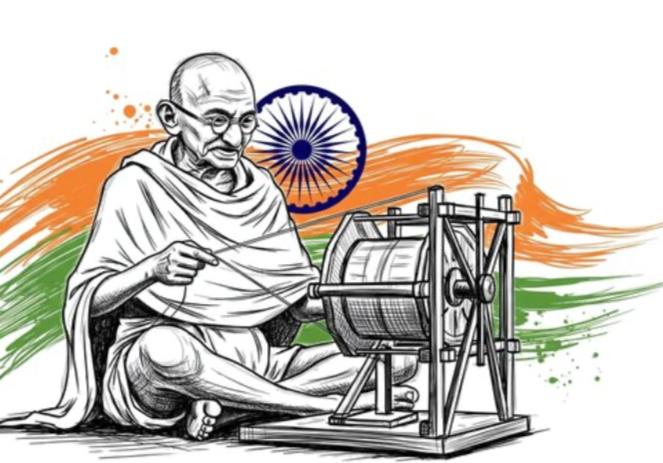
✍️ The Gentle Warrior: Mahatma Gandhi’s Life and Legacy
On October 2nd, the world commemorates the birth of Mohandas Karamchand Gandhi — a man whose quiet strength and unwavering commitment to truth transformed the destiny of a nation. Revered as the “Father of the Nation” in India, Gandhi’s life was a testament to the power of nonviolence, simplicity, and moral courage.
🌱 Early Life and Values
Born in 1869 in Porbandar, Gujarat, Gandhi was raised in a devout Hindu household. His upbringing instilled in him values of honesty, humility, and compassion. As a young man, he traveled to London to study law, and later to South Africa, where he first encountered the brutal realities of racial discrimination. It was in South Africa that Gandhi began to shape his philosophy of Satyagraha — the force of truth and nonviolent resistance.
🧘♂️ A Life of Simplicity
Gandhi’s lifestyle was as radical as his politics. He wore simple homespun clothes, lived in modest ashrams, and practiced vegetarianism and fasting as spiritual discipline. He believed that true change began within — that one must “be the change you wish to see in the world.” His rejection of materialism and embrace of simplicity became a symbol of moral clarity in a world torn by greed and violence.
✊ The Fight for Freedom
Gandhi returned to India in 1915 and quickly became a central figure in the struggle against British colonial rule. But unlike many revolutionaries, Gandhi’s weapons were peace, patience, and protest.
- Non-Cooperation Movement (1920–22): Gandhi urged Indians to boycott British institutions, schools, and goods. Millions followed, shaking the foundations of colonial control.
- Salt March (1930): In a brilliant act of civil disobedience, Gandhi walked 240 miles to the Arabian Sea to make salt — defying British laws. The march galvanized the nation and drew global attention.
- Quit India Movement (1942): Amid World War II, Gandhi demanded immediate British withdrawal. His slogan “Do or Die” became a rallying cry for independence.
Despite arrests, beatings, and long imprisonments, Gandhi never wavered in his commitment to nonviolence. His protests were not just political — they were deeply spiritual, rooted in the belief that truth and love could conquer injustice.
🌍 Global Impact
Gandhi’s influence extended far beyond India. His philosophy inspired leaders like Martin Luther King Jr., Nelson Mandela, and the Dalai Lama. He showed the world that moral force could be stronger than military might — that peace could be revolutionary.
🕊️ Final Days and Legacy
India gained independence in 1947, but Gandhi’s joy was tempered by the horrors of Partition. He spent his final months trying to heal communal wounds between Hindus and Muslims. On January 30, 1948, Gandhi was assassinated by a Hindu extremist who opposed his message of unity.
Yet Gandhi’s death did not silence his voice. His teachings continue to echo in movements for justice, equality, and peace around the world.
🌟 TL;DR: Gandhi’s Legacy in a Nutshell
- Gandhi’s life was defined by nonviolence, truth, and simplicity.
- He led India’s freedom struggle through peaceful resistance, including the Salt March and Quit India Movement.
- His philosophy of Satyagraha inspired global leaders and movements.
- Gandhi’s legacy lives on as a beacon of hope for peaceful change.