
1. Introduction
Independence Day stands as a powerful reminder of the sacrifices and struggles that shaped our nation’s destiny. Celebrated annually on the 15th of August, it marks the historic moment in 1947 when India emerged from the shackles of colonial rule to embrace the light of liberty. This day is not merely a commemoration of past triumphs but also a reaffirmation of our commitment to uphold the ideals of democracy, unity, and progress.
2. Historical Background
For over two centuries, India endured the political, economic, and cultural domination of British rule. The journey to freedom was neither swift nor easy—it was paved with relentless protests, non-violent resistance, and armed uprisings. Leaders like Mahatma Gandhi, Jawaharlal Nehru, Subhas Chandra Bose, and countless unsung heroes mobilized the masses through movements such as the Non-Cooperation Movement, Civil Disobedience Movement, and Quit India Movement. The culmination of decades of struggle finally came on 15th August 1947, when the Indian tricolour was hoisted for the first time at the Red Fort.
3. National Celebrations
Independence Day is celebrated with great enthusiasm across the nation. The Prime Minister’s address from the ramparts of the Red Fort is a highlight, where achievements are reviewed, challenges acknowledged, and a vision for the future outlined. Patriotic songs, cultural programs, and flag-hoisting ceremonies take place in schools, offices, and public spaces, fostering a spirit of unity and national pride. Streets and homes are adorned with saffron, white, and green, creating a festive atmosphere.
4. Significance of the Day
Independence Day is more than a holiday—it is a day of introspection. It reminds us of the cost of freedom and the responsibilities that accompany it. It is an opportunity to honour the sacrifices of freedom fighters and to renew our dedication to protecting the sovereignty and integrity of our nation. The day serves as a bridge between our glorious past and the aspirations of our future.
5. Role of Youth in Preserving Freedom
The youth of India are the torchbearers of the nation’s destiny. Their role extends beyond academic and professional achievements—they must actively participate in civic life, champion social causes, and promote inclusivity. By nurturing innovation, fostering communal harmony, and standing against corruption and injustice, the younger generation can ensure that the hard-won independence is preserved for centuries to come.
6. Challenges in the Modern Era
While India has made significant progress since 1947, challenges remain. Economic inequality, environmental degradation, and social divisions continue to test our unity. The ideals of freedom, equality, and justice must be protected not only from external threats but also from internal weaknesses. Independence Day is a timely reminder that liberty must be guarded vigilantly, and that every citizen has a role in nation-building.
7. Cultural Expressions of Patriotism
Independence Day serves as a canvas upon which India’s rich cultural diversity paints itself in vibrant hues. Folk dances, traditional music, and theatrical performances bring regional histories and local heroes to the forefront. Schools and community centres organise essay competitions, debates, and poetry recitals on themes of patriotism and nation-building. Such activities not only entertain but also deepen the public’s understanding of the nation’s cultural heritage, reminding citizens that unity thrives amid diversity.
8. The Role of the Armed Forces
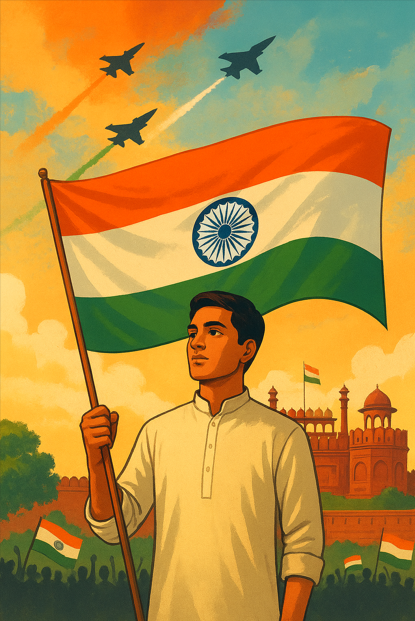
The Indian Armed Forces are the silent sentinels who safeguard the freedom won through decades of struggle. On Independence Day, their role is honoured through ceremonial parades, aerial displays, and public tributes. The sight of the armed forces marching in precision or jets painting the sky with the tricolour is more than mere spectacle—it is a visual reaffirmation of the nation’s security and sovereignty. Beyond ceremony, it is also an opportunity to recognise the ongoing sacrifices of soldiers posted in challenging terrains and conflict zones.
9. Independence Day in the Global Context
For the Indian diaspora spread across continents, Independence Day is a powerful link to their homeland. Celebrations in foreign cities often include flag-hoisting at embassies, cultural showcases, and community gatherings. These events highlight India’s global identity as a nation rooted in ancient traditions yet forward-looking in vision. The observance of Independence Day abroad also fosters cross-cultural understanding, allowing other nations to witness and appreciate the resilience, creativity, and unity of the Indian people.
10. Symbolism of the National Flag
The Indian tricolour is more than a piece of fabric—it is a living emblem of the nation’s ideals. The saffron at the top represents courage and sacrifice; the white in the middle stands for peace and truth; and the green at the bottom signifies faith and fertility. At the centre, the navy blue Ashoka Chakra, with its 24 spokes, embodies eternal motion and the virtues of righteousness. On Independence Day, the flag becomes a unifying force, inspiring citizens to rise above divisions and work towards a shared future.
11. Media and Technology in Modern Celebrations
In the digital age, Independence Day celebrations have transcended physical boundaries. Live telecasts of the Prime Minister’s speech, online cultural events, and social media campaigns enable millions to participate virtually. Digital art, patriotic music videos, and historical documentaries circulate widely, reviving the stories of freedom fighters for younger audiences. Technology has not replaced traditional celebrations but rather expanded their reach, ensuring that the spirit of the day resonates in every corner of the globe.
12. Environmental Responsibility on Independence Day
While celebrations are joyous, they must also be mindful of environmental impact. The use of non-biodegradable materials for decorations, excessive plastic flags, and noise pollution from fireworks can undermine the values we celebrate. Increasingly, schools and communities are adopting eco-friendly practices—using cloth flags, planting trees, and promoting clean-up drives—to mark the occasion. This approach ties national pride to environmental stewardship, reinforcing the idea that freedom also entails responsibility towards our planet.
13. Reflection and Renewal
Independence Day is as much a moment for reflection as it is for celebration. It invites citizens to assess the nation’s progress, confront its shortcomings, and commit to a renewed vision for the future. The day’s ceremonies, cultural programs, and public speeches collectively serve as a moral checkpoint—a reminder that independence is not a static achievement but a continuous process of building, protecting, and nurturing the nation’s democratic and ethical foundations.
Conclusion
Independence Day is not just a celebration of the past; it is a pledge for the future. It calls upon each of us to honour the sacrifices of our ancestors by contributing positively to the nation’s progress. As we unfurl the tricolour, let it not only symbolise our pride in being Indian but also inspire us to work tirelessly towards a just, prosperous, and harmonious India. True freedom lies not merely in independence from foreign rule but in the liberation of minds and hearts from prejudice, fear, and apathy.